Period Pieces: A Slap In The Face

Period Pieces: A Slap in the Face

Check out the Period Pieces blog, a journey through the bizarre and beautiful cultural history of menstruation. Inspired by #throwbackthursday, they serve up our favorite ads, images, and factoids about periods throughout the ages.

Imagine you’re twelve years old, and you’ve just discovered a stain in your underwear. It’s your first period. You don’t totally understand what’s happening, so you pull up your pants and run downstairs to tell your mother. You expect a hug, a calming caress, a kiss on the forehead. Instead, she slaps you across the face when you tell her.

cartoon faces

If you were a young Ashkenazic Jewish girl 50 years ago, this may have happened to you. While it’s by no means a common custom these days, some mothers may still give a firm tap upon learning of her daughter’s menarche. The purpose and origin of the “menstrual slap” is unclear. Some traditions say that it’s to bring a quick rush of blood to the face, pulling it away from the lower abdomen and relieving a potentially heavy flows. Others see it as a harsh awakening: the transition from girlhood to womanhood made punctuated with a physical action. Either way, it’s a fascinating example of the strange and unique customs throughout history to “celebrate” a girl’s menarche.

Learn more about the tradition of the “menstrual slap” at the Museum of Menstruation.

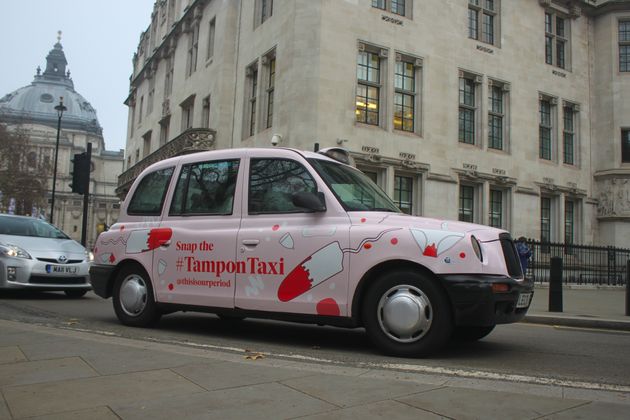
Tampon Taxi?

This Tampon Taxi Is Delivering Sanitary Products To Homeless Women

Hail this cab to help end period poverty 👋

More than 40 per cent of girls in the UK have had to use toilet roll to manage their period because they’ve struggled to afford sanitary products. But campaigners are hoping to change that with a London taxi with a difference.

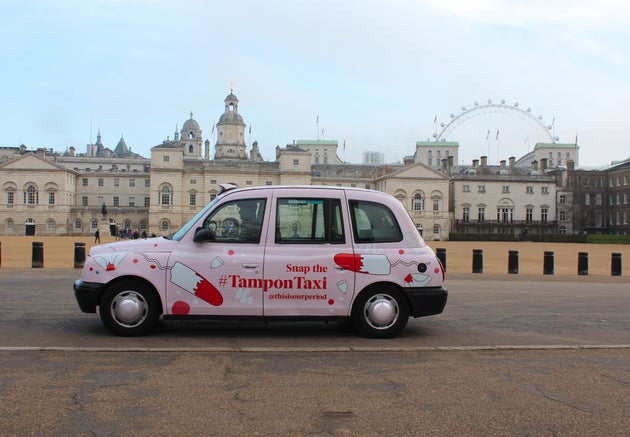
The black cab has been given a pink makeover and is now adorned with tampons, Mooncups and sanitary towels. It’ll be driving around London from today until 19 December, operating as a regular cab to raise awareness of period poverty both in the UK and abroad.

It’ll also be making some special stop offs on the way, handing out 5,000 sanitary products to women at homeless shelters across the capital.

PROJECT PERIOD

The idea is the brainchild of Holly Bantleman from Project Period, a coalition of period poverty campaigners. Bantleman came up with the idea while having a “cheeky margarita” in an outside bar in the summer and seeing a pink taxi go past.

She hopes the taxi will raise awareness about period poverty, as well as encourage more people to donate and volunteer with period poverty charities.

[Read More: 7 Things You Really Need To Know About Period Poverty]

Through her work, Bantleman has witnessed the devastating impact period poverty has on women and girls both here and abroad.

“The impact on someone’s confidence, on their sense of pride, is huge,” she tells HuffPost UK. “I’ve spoken to women who are unable to take public transport because they’re on their periods and can’t leave the house, and that ends up having an impact on their work and the funds that they’re able to take home to their families.”

PROJECT PERIOD

Period poverty also has a huge impact on education, with thousands of girls around the wold missing school when they’re on their period.

“There are points where I’ve known young girls who have exchanged sex for sanitary products,” Bantleman says.

When girls and women in the UK are forced to use toilet tissue in place of sanitary products, it can leave them worried about leaking, seriously restricting their daily lives.

But elsewhere in the world, Bantleman says loo roll may not even be available.

“People end up using crude materials like banana leaves, mud and rags, which can have an impact on a woman’s reproductive and personal health,” she says.

Campaigns like Project Period are working to ensure that all people who need sanitary products have access to them. The taxi will be driving around London until 19 December – find out more about the organisation’s work here. 

Language and Autonomy

There’s no shortage of serious conversations parents should have with their children. And in the age of the Me Too and Time’s Up movements, one fundamental lesson is the importance of our bodies and bodily autonomy.

“Body awareness talks are the earliest conversations parents can have with young children to support their health and safety,” sex educator Melissa Carnagey said. Conversations about body parts and bodily autonomy lay the foundation for understanding consent and sexual misconduct.

To inform these early discussions, HuffPost spoke to Carnagey and sex educator Lydia M. Bowers about the best ways to explore the topic of private parts and bodily autonomy with young kids.

Here are their expert-backed guidelines and tips for parents and caregivers to keep in mind.

Use The Proper Terms For Body Parts

“Body parts are body parts are body parts,” Bowers said, emphasizing that “penis,” “testicles,” “vulva” and “vagina” are not bad words. Parents should become comfortable using these terms or the corresponding words if they speak a language other than English at home.

“Often without hesitation, caregivers will use accurate terms for body parts like elbow, knee and nose, so parts like the penis, vulva, vagina and anus should be no different,” said Carnagey.

There are several reasons children should learn the proper terms for private parts instead of nicknames. One is that having the right language and context helps kids communicate clearly about their bodies. This is important in the context of telling a doctor or caregiver where something hurts or itches.

“When we avoid saying words, we instill a sense of shame, of something to be avoided or hidden.”

– LYDIA M. BOWERS, SEX EDUCATOR

“Using accurate terms also better prepares them to talk confidently about changes they may experience to their body as they grow, especially to medical providers or in settings where they may be learning about their health,” Carnagey added.

“When we avoid saying words, we instill a sense of shame, of something to be avoided or hidden,” Bowers said. She added that using the correct terms is useful in teaching kids how to keep their bodies clean and healthy. “For proper hygiene, there’s a difference in how the bottom or the penis or the vulva are wiped and washed.”

Avoid Cutesy Language

Although it is tempting to use euphemisms and cutesy language when talking to little kids about their bodies, this can lead to problems.

“One issue is that there are so many alternate terms and many of them have other meanings. This can be risky because it can lead to a child being misunderstood by others, especially if they have experienced unsafe touch to that part of their body and need to report it,” said Carnagey.

Kids should be able to identify body parts as private and correctly name them so that they can communicate if they’ve been touched inappropriately.

“We sometimes give nicknames for body parts ― like ‘piggies’ and ‘noggin.’ But just like we also teach children those parts are actually called ‘toes’ and ‘head,’ they need to know real private-part terms as well,” Bowers explained. “If we’re using cutesy names because we’re embarrassed or ashamed to say the actual terms, we’re perpetuating the idea that some body parts are dirty, bad or shameful.”

Promote Bodily Autonomy In Everyday Situations

“Creating a home culture where everyone’s body boundaries are respected is an important step,” Carnagey said. Parents can do this by not forcing their kids to share affection with others and by getting in the habit of asking for touch ― for example, saying “May I give you a hug?” rather than “Give me a hug.”

Carnagey advised that parents not dismiss unwanted touch between siblings or family members as play.

“In our home, for example, we have an agreement that no one should have to repeat ‘no’ or ‘stop’ before the boundary is respected,” she explained. “It may take some reminding and redirecting at first, but when it’s consistently practiced, children become more mindful of the boundaries of others and come to expect theirs to be respected as well.”

Parents and caregivers can promote bodily autonomy in everyday circumstances like mealtimes. “When a child says that they are full or finished eating, avoiding a power struggle by not forcing them to take one more bite or finish their plate honors what their body is telling them,” said Carnagey.

Bowers pointed out that there are opportunities to teach these lessons while reading books or watching movies. Parents can say things like, “Should that prince have kissed the princess when she was sleeping? She wasn’t able to say yes or no.”

According to her, there are times that parents should not insist on asking for permission, however, like when changing diapers, taking kids to the doctor to receive medical care and bathing young children before they’re able to do it on their own.

“If we ask a child, ‘May I change your diaper?’ and they respond with ‘no,’ we’re left with two options. Either we violate their consent or we leave them in a dirty diaper, which is a health and safety hazard,” she explained. “Instead, we talk through with them. ‘It’s time to change your diaper. Your body did its job to get that out, and now we’re going to take off the dirty diaper. I’m going to use this wipe. …’ We can still show them that their body is worth respect, that we will be intentional and inform of the process.”

Use Books And Videos

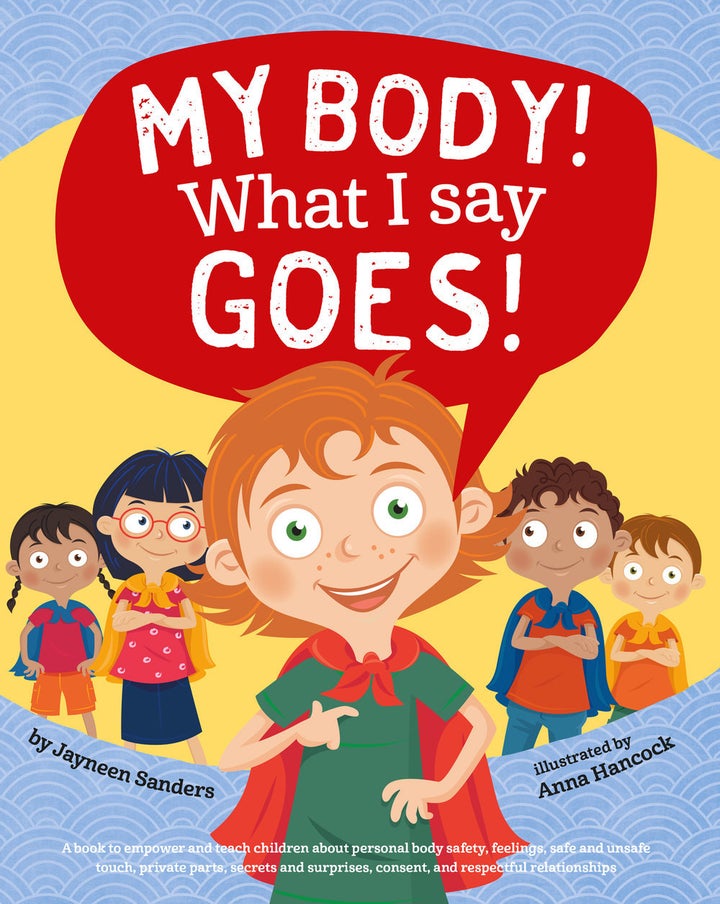
Many children’s books promote themes of bodily autonomy and safety. Bowers and Carnagey recommended Jayneen Sanders’ books, especially No Means No!,Some Secrets Should Never Be Kept and My Body! What I Say Goes! Sanders also has a book geared toward caregivers called Body Safety Education.

EDUCATE TO EMPOWER PUBLISHING
Many children’s books — for example, Jayneen Sanders’ My Body! What I Say Goes! — promote themes of bodily autonomy and safety.

Educate2Empower Publishing, Sanders’ publisher, is a great resource for families because it is an imprint specializing in children’s books on body safety, consent, gender equality, respectful relationships and social and emotional intelligence.

Carnagey’s Sex Positive Families website features a reading list of over 100 books on sexual health for children and families, including many that tackle consent and bodily autonomy.

Bowers is a fan of What Makes a Baby by Cory Silverberg. “It’s a great basic intro into how babies are made, using the terms ‘sperm,’ ‘egg,’ ‘uterus’ and ‘vagina,’” she said. She also recommended C Is for Consent and Miles Is the Boss of His Body.

Teach Kids To Trust Their Instincts

There are ways to help kids learn to trust their instincts, which can be a fundamental step in teaching bodily autonomy and contextualizing difficult experiences.

“Being in the habit of checking in and making space to hear from them how they are doing in a moment is a great way to help increase their body awareness and language around their experiences.”

– MELISSA CARNAGEY, SEX EDUCATOR

Carnagey suggested teaching kids to identify their feelings. Parents and caregivers can do this by asking questions like “How are you feeling right now?” or pointing out when they notice shifts in body language with statements like “I see that you’re frowning. Tell me what you’re feeling.”

“Being in the habit of checking in and making space to hear from them how they are doing in a moment is a great way to help increase their body awareness and language around their experiences,” she said. “This can make them more confident communicators and advocates for their wants and needs along their journey.”

When Your Child Doesn’t Look Their Age

When Your Child Doesn’t Look Their Age

EVGENY ATAMANENKO / SHUTTERSTOCK

Last month, I took my daughter to our local driving school to sign up for driver’s ed. The director took one look at my 15-year-old and chuckled. “You don’t look old enough to drive,” he said. “My 12-year-old niece looks older than you!” He attempted to say it lightheartedly, as if we were all in on the same joke, but as anyone with a shred of awareness knows, unsolicited comments about looking three years younger than your age isn’t a welcome conversation starter for a teenage girl. She was not amused.

My daughter began looking younger than her age when she was about 6. As her peers grew taller, she stayed petite. Her same-aged girlfriends started filling out a full two or three years before she did, and she’s not been thrilled with those differences. “When am I going to grow, Mom?” she often asks, equal parts annoyed and angry at the unfairness of it all. I try to convince her that she’s built just the way she was meant to be, and that she’ll grow if and when the time is right — which, of course, only ticks her off further. I try to tell her there are benefits to being short, but she doesn’t want to hear it. She wants to be tall, to at least look her age, to not have people always pointing out how young she appears.

But there actually are some advantages of having kids who are small for their age. For one, they usually come across as smarter, more skilled, and more mature than their peers. For example, my daughter played violin beautifully when she was 11, but the fact that she looked like she was 8 made it even more impressive. We have a friend whose tiny 4-year-old still wears size 2T pants, so when he opens his mouth and a full, intelligent thought falls out, you can see the shock on people’s faces as they think, “Wow, what an articulate toddler!”

I’ve also had friends with kids on the other end of the spectrum. The kids who look a lot older than their age face a whole host of challenges, from constantly outgrowing clothing to unrealistic expectations. People expect much more maturity out of physically bigger kids, so the judgmental looks come swift and hard toward parents who are gifted with early-blooming children

I have another friend whose son is 6 and is the same height as his mother — and she’s not short. He isn’t just a little tall for his age; he’s ginormous. He wears clothes most 12-year-old boys can wear, so you can imagine what people think when he behaves like a typical first-grader. He’s a little kid trapped in a big-kid body, but strangers don’t know that. All they see is a big kid whose parents clearly haven’t civilized him properly.

Or how about the girls who develop early? I knew someone whose 10-year-old wore a C-cup bra and looked like a teenager in a swimsuit. Talk about unreasonable — not to mention inappropriate — expectations from the public.

I know that this is something parents of developmentally delayed kids also have to deal with — along with a whole host of other issues — so it’s given me a newfound sense of empathy. While having your child’s age miscalculated is hardly a huge life challenge in the grand scheme of things, it can be tricky.

We live in a world where people tend to be critical of kids’ behaviors anyway, and having a child whose insides don’t match their outsides naturally leads to assumptions and expectations that are either inaccurate or unfair. Not to mention, it gets old to constantly have your kid’s physical size be the first topic of conversation, or to repeatedly say things like, “Yes, I know, she’s really small for her age,” or “No, he’s not reading because he’s 3. He only looks 7.”

It’s good for all of us to remember that kids may not be what they appear at first sight, especially when we are tempted to judge. When a mom brings a boy who must surely be 9 or 10 into the women’s bathroom with her, he may only be 5. When you think, “Why is that kid still using a pacifier?” that kid may not be as old as they look.

I actually had to remind myself of this when I dropped my daughter off for her first class at the driving school. You have to be 15 to take the class, but I watched a kid who looked like he couldn’t possibly be older than 11 — no exaggeration — walk in and sit down in front of my daughter. She and I exchanged a quick, wide-eyed glance, and I’m sure a look of pity crossed my face for the poor boy.

My daughter just looked at him and smiled.

How To Use A Tampon

I’ve been wondering how this should go…,


How to Teach Girls to Use a Tampon the First Time

How to Use a Tampon: Help Your Daughter’s First Time Using A Tampon

Tampon-Talk. Girls fear it and mothers dread it, but it doesn’t have to be so hard. In addition to being a sexual health educator, I fancy myself somewhat of a comedian and by the end of one of my Period-Prep workshops, girls are rolling with laughter and moms are eager to share their stories. Comedy and storytelling have amazing powers and can help any mother master the art of all things vagina, including instructing our daughter’s in inserting a tampon.

Every woman has a tampon story to tell. Some are terribly sad, some uneventful, and some are surprisingly hilarious. These stories deserve to be told and are extraordinarily useful tools for starting historically awkward conversations like Tampon Insertion 101. These are some of the more common themes I’ve heard, which you can share with your own daughters.

HER FIRST TAMPON: INSTRUCTIONS TO DEMONSTRATIONS

The Show and Tell

This scenario most typically happens when a girl needs to figure out how to use a tampon for the first time ASAP, thanks to a surprise visit from Aunt Flo before some event: swimming, gymnastics or any other sport that involves skin-tight uniforms. Frantic girls can be found in bathrooms, searching wildly for their vaginas and discarding unsuccessful tampons like the shells of a peanut. Mothers, hovering just outside the stall whisper, “Are you OK?” or “How’s it going in there, sweetie?” or “Are you getting any closer? Your swim meet starts in 6 minutes!”

As things get down to the wire, some mothers will make the desperate decision to drop drawers, and give a 3-D demonstration. And you thought talking about vaginas was awkward—try giving a full-blown vagina show and tell. Embarrassing? Yes, but an amazing opportunity to bond with your daughter and for her to see just how much you love her (she might think you’re just trying to embarrass her, but when she’s twenty, she’ll get it).

The Step-By-Step

The step-by-step involves a girl in a bathroom wondering how to use a tampon, with a mom shouting instructions from the hallway, face smashed up against the crack of the door to better be heard.

Mom: “Just… just find the biggest hole down there and stick it in – wait, no! Not the biggest hole, the second biggest hole!”

Mom: “Find the one just under your clitoris and past the hole where your pee comes out—it’s hard to see, but it’s there. Use your fingers to feel for it.”

Daughter: “Huh! What’s a clitoris? And double ewww. I’m not going to touch myself there!”

Mom (curses self for leaving clitoris out of the puberty talk): “It’s just your vagina. If you want to find the hole, touch the damn thing!”

Daughter (3 minutes later): “Ok, I found it! I’m unwrapping the tampon and am going to try to put it in.”

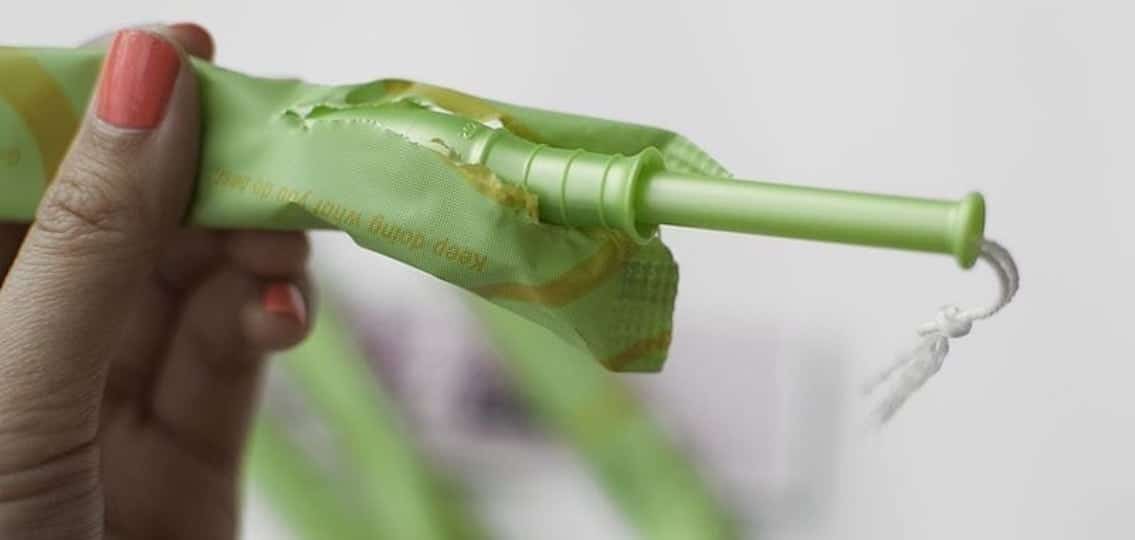
Mom: “Don’t take the cotton thingy out of the plastic thingy! Stick the plastic thing up your vagina and then press that skinny stick and the cotton part will shoot out like a bullet and stay up there.”

You get the picture. It’s complicated.

The Do-It-Yourself

This method is arguably the most invasive of the bunch and basically involves a mother getting up close and personal with her daughter’s junk. I’ve instructed scores of girls on how to use a tampon, but never have I had to put a tampon in another person’s body (I’m hoping to keep it that way). My daughters, at 6 and 8 years old, have heard plenty of my stories and lurked in my bathroom enough times to know the low-down on tampons, but should my motherly obligations ever require me to perform The Do-It-Yourself technique, without a doubt, I will show up and suit up, tampon in hand and ready to roll.

HOW TO TEACH YOUR DAUGHTER TO USE A TAMPON

In all seriousness, girls do need specific guidance when trying out tampons for the first few times. Here are a few pointers to give your daughter specific and helpful advice on how to insert a tampon:

1. FIGURE OUT WHAT’S WHAT.

Advise that she find her vaginal opening and to insert her finger as far as it will go (wash with soap first) before trying to insert the tampon. Once she finds the opening and understands her own anatomy, which can be the hardest part, it will be much easier to start the process and save her the frustration of poking herself a million times.

2. USE VISUALS.

Show her a diagram with a side-view of the female reproductive system and point out the angle of the vagina and how it slants towards the spine. It helps if she holds the tampon at a 45-degree angle as she inserts it.

3. BE SPECIFIC. 

Be sure to tell her to insert the tampon into her vagina as far as it will go (without causing pain); if her tampon is even remotely sticking out of her vagina, it will cause discomfort and possibly pain. It’s also important that she knows that the applicator must be inserted all the way into her vagina before she pushes the tampon out.

4. START SMALL (and PLASTIC).

Plastic applicators are the easiest to use, and be sure to buy small tampons geared towards the tweens and teens.

5. TEACH SAFE TAMPON USE.

Fortunately, toxic shock syndrome is rare these days, but it’s still important to teach girls to use tampons safely. Specifically: use the lowest absorbency possible; change tampons every three hours; don’t leave tampons in over night; consider using tampons for just a few days; and wash your hands.

These aren’t the only methods employed and some girls get no help at all. Whatever your technique, any help at all can go a long way and bravo for trying. Consider having a girls’ night, with several mother-daughter pairs clad in jammies and eating pizza – the group dynamic is fun and can significantly increase the quality of the conversation. You can do it, and don’t forget how to tell them to take the damn thing out!


Jill Pond

Jill Pond is a seeker, writer, and blurter of truth. She is wife to a hoarder of camping gear, mother to two wild girls, and walker of two stinky dogs. Comedic with a twist of serious, the stories on her blog Totally Inappropriate Mom detail adventures in life.

A Mixed Experience

I left this under good advice because her sister was kind.

One weekend when I was 12 years old my mother flew to West Palm Beach to see my cousin.  I went to the bathroom and some some blood on the paper.  I knew it was my period.  I ran to my 16 year old sister and told her I thought I had gotten my period and was worried bc mom was away.  She said no problem and that she’d take care of me.  She gave me a pad.  A little while later I described my cramps to her.  Again, no problem for a seasoned teenage girl.  She got me pamprin.  I can still remember the daisy like imprint on the tablets.  I was impressed that there was medicine just for this type of pain.  Later when Advil became popular I was happy because it destigmatized having a period and all that goes with it.  I was just taking a pill like an ordinary person would.  While that was liberating, looking back it’s kind of sad that I felt that way.  It probably has to do with period shaming.  I was at once thrilled with Pamprin, and thrilled to be just normal with the use of Advil.  That was that, and I was sad my mom wasn’t around to share that experience with me.  I’m sure that nowadays with a lot more moms that travel for work, a lot more girls will be without their mothers when the time comes.

Almost A Real Life Horror Movie!

It was 1986 and I was in sixth grade. Much to my chagrin, I began to get hair on my legs that year. Most of the time knee socks took care of the “problem,” as we wore uniforms. One day all of the girls were rolling down their socks and I rolled mine down, one of my friends exclaimed, “OH MY GOD, LOOK AT THAT HAIR!” I wanted to die. So, that night when I got home, I snuck into my mom’s bathroom and swiped her razor. Armed with nothing but a dull razor and a sense of desperation, I started the job. Unfortunately, the only result was a pair of hacked up, semi-smooth legs. That night, my legs bled all over my bed. The next morning, I got the “talk” as my mom had seen the bloody sheets. In order to hide my crime, I pretended that I had gotten my period. The next week, a girl saw the pads in my closet and told everyone at school. Despite my protestations and my story of the hacked-up legs, no one believed me. Needless to say, when I actually DID get my period several months later, I had no one to tell. I couldn’t tell my mom for fear that she would be angry and I couldn’t tell my friends as they wouldn’t believe me. I ended up telling my mom when I was about 20 and she was so upset that I kept it from her. To this day, this story encapsulates all of my preteen angst.