Why Is A Period Scene In A Movie So Shocking?

Mary Queen of Scots’ period blood is not only normal, it’s integral to her story

As the film shows, all eyes at court would have been trained on whether she was going to produce an heir.

In Josie Rourke’s glorious Mary Queen of Scots film, one scene is supposedly wildly shocking. It’s not the harrowing segment that portrays a savage, gory murder – nor one of the grisly battle shots. Instead, it is a quiet, candlelit moment in Mary’s bedchamber when, with her marmalade hair loose to her waist and clad in a creamy nightgown, she is washed by her giggly coven of gentlewomen. One of them remarks that she’s early getting her period, and a bit of blood splashes into a bowl. So. Not quite one for the smelling salts. It is about as shocking as a Calippo.

Yet, as is de rigueur when the conversation turns to lady things (because talking about this stuff without employing euphemism is punishable by death), some people have been working valiantly hard to be scandalised. While promoting the film, Rourke has been treated to questions about how difficult it was to shoot the scene. (A fair enquiry. Come on, it must be nail-bitingly tricky to capture Saoirse Ronan – who plays Mary and who is, let’s face it, quite good at acting ­– standing in her bedroom accompanied by minimal other cast members.) The BBC also published a news story with the (now edited) headline “Mary Queen of Scots director Josie Rourke defends menstrual blood scene.” This was confusing. Perhaps they meant to replace the words “menstrual blood” with “real life kitten execution”? As Rourke tweeted, the scene “requires no defence”.

Of course it doesn’t. Aside from being a so-normal-as-to-be-boring part of life for half of the population, depicting Mary’s fertility makes perfect sense in a film whose storyline hinges on the continuation of dynasties. After all, royal bodies weren’t (and still aren’t) just personal: the queen’s cycle was of colossal political importance, too. All eyes at court – and at courts across the land – would have been trained on whether she was going to produce an heir. In the movie, Elizabeth I, Mary’s presumed rival, wonders about it. And there is so much chatter about it in the Scottish court that Mary has to host a kind of flower-laden medieval baby shower to stop tongues wagging. To not include Mary’s period would have been like omitting the apples in a film about fruit bowls. It is central to the story, and therefore it should be seen.

Granted, most women’s periods don’t carry the political significance of Mary’s – but this is nevertheless a lesson that applies to films and TV in general. Periods are a key thread in the fabric of women’s lives, yet the scaredy-cat screen world doggedly refuses to reflect this. Portrayals that ring true (Girls showing Jessa realising she’s bleeding in the middle of a make-out session) are far outweighed by negative, brain-dead ones (side eyes to Carrie’s stigma-cementing depiction). Both of these categories are, of course, trumped by the number of times periods aren’t mentioned at all: the lengthy memory-jogging Googling required to come up with the examples in the previous sentence is testament to this point.

The squeamishness of the screen world no doubt mirrors society’s attitudes as a whole. Until Bodyform’s #bloodnormal advert in 2017, advertising for period products was profoundly bonkers, with menstruating women displaying a baffling fondness for standing in fields, smiling, and blue gunk deemed a logical stand in for blood. Meanwhile, the shame around periods – along with a hefty dose of poverty – means girls in the UK are missing school because they cannot afford sanitary towels. And last month, I fell over in a branch of Sainsbury’s after diving compulsively to retrieve a tampon that had fallen out of my bag, lest it burn out the eyes of an innocent passer-by.

Preparing Your Child For Sleepaway Camp

Sleepaway Camp encourages kids to move outside their comfort zone, try new things, and master ski…

Learn how to prepare your child for Sleepaway Camp!

Sponsored by YMCA

Above all, Mary Queen of Scots excels at showing how women’s bodies are so often weaponised against them. Mary’s physicality – her sexuality, her fertility – is wrapped up in her femininity, and this is what ultimately bites her on the bum in the man’s world of the 16th century court. Depressingly, this resonates today, in a landscape where women are still undermined by references to their appearances – and putting a period on screen can spark such a fuss. Happily, though, the film subverts stigma just as much as it exposes it. Its depiction of female bodies may not be shocking – but its normalising stance might just jolt us into altering our reaction towards them.

Gwen Smith is a freelance arts journalist, and was formerly a feature writer for the Mail on Sunday’s culture supplement, Event.

Opinions please….What’s your take on a Period Party?

Personally, the word mortified comes to mind…


Comedian Bert Kreischer shared an entertaining story while appearing on “Conan” in August 2018. The topic: His daughter’s “period party.”

When Kreischer’s younger daughter first started her period, she asked him to pick up some supplies for a period party. She responded to his initial confusion by noting that “all the girls are throwing them” and instructed him to buy red velvet cake and icing to decorate it with the “name” of her period.

The dad quickly got on board.

“I had the best time of my life! I got beet juice, pomegranate juice, pasta with marinara sauce, ketchup and fries, red velvet cake, red wine!” he told the “Conan” audience. “It was awesome. I hope to God you hear it in a positive manner, and you fathers get to throw your daughter a period party.”

While “Flo” is obviously a popular pick for a period “name,” Kreischer proudly noted that his daughter chose “Jason” because the date of her menarche was Friday the 13th.

Although the idea of a “period party” may seem strange, Kreischer actually touched on something that’s not so uncommon: Many parents and their daughters celebrate this milestone in festive ways.

While some people just like to take advantage of any occasion to throw a theme party, there are generally more profound motivations behind period parties.

For many, this kind of celebration is a way to destigmatize and minimize the sense of shame around periods ― a topic that’s still considered embarrassing or taboo to talk about. Period parties also present the opportunity to address some of the fear, uncertainty and confusion young people feel around menstruation.

In January 2017, a Florida mom’s “period party” for her daughter went viral on Twitter. Twelve-year-old Brooke Lee’s mother Shelly organized the event to ease the preteen’s anxiety around starting her period.

She invited close friends and family, and they celebrated with pizza, a cake with red and white icing and menstrual product gifts.

View image on TwitterView image on TwitterView image on Twitter

Autumn Ayala@autumn1shea

Brooke started her period today & my family is super extra 😂😩

7,172 people are talking about this

Poet Dominique Christina described a period party she threw for her 13-year-old daughter while introducing her powerful piece, “The Period Poem,” at a spoken word event in 2014.

“And so then my daughter, she starts her period, and she’s stricken and walks out the bathroom looking like she’s died or something. And I wanted to undermine that,” Christina said. “So I threw her a period party, my homies rolled up, dressed in red, and there was red food and red drinks. It was great. All red everything.”

Some people refer to this kind of event as a “first moon party” or “red tent party,”which appears to be a reference to Anita Diamant’s The Red Tent. (The book follows the biblical character Dinah, a daughter of Jacob and sister of Joseph, and its title refers to her tribe’s tradition of women menstruating together in a special tent.)

For some people, the concept of a period party may sound a bit embarrassing and over the top, but menstruation-related celebrations are relatively common in certain cultures.

In Tamil communities, there’s a special coming-of-age ceremony and party to mark the occasion. The Navajo have a ritual called KinaaldaMany Japanese families historically made a nod to a daughter’s first period by serving sekihan, a dish associated with special occasions that features rice and adzuki beans (which have a reddish color).

Needless to say, the period party concept isn’t particularly new, but the modern, American, red velvet cake version seems to be catching on in our social media-driven world. Pinterest is full of period party ideas. The Instagram hashtag #periodparty brings up photos of menstruation-themed desserts and other festive fares. The parenting website Mommyish even offers a guide called “First Period Party Ideas Your Daughter Will Hate You For.”

Pinterest is full of food and decor ideas for a "first moon party" or "rent tent party."

Pinterest is full of food and decor ideas for a “first moon party” or “rent tent party.”

This concept also has a history in pop culture. When the character Rudy Huxtable started her period in a 1990 episode of “The Cosby Show,” matriarch Clair wanted to honor the occasion with a special “Woman’s Day.”

Supermodel Tyra Banks’ mother, Carolyn London, threw her teenage daughter period party, which the two women described in their book, Perfect is Boring.

“One day, I was watching a National Geographic special and saw that in almost every primitive culture, there was a rite of passage ceremony where the women would come together to honor a girl who had just started her period and teach her all about it,” London wrote. “It was a celebration of womanhood, and an acknowledgement of passing into another realm.”

Inspired by this concept, the mom decided to host a party for Tyra. She invited her daughter’s friends, ordered a cake that said “You’re a Woman Now,” decorated the house in Tyra’s favorite color yellow, and put together a menstruation gift basket. During the party, London “gave them all the complete breakdown” of menstrual products, hygiene, anatomy and more. The party was reportedly such a hit, she threw similar events for her nieces as well.

“I appreciate that my mother never wanted me to be ashamed of anything, or to think that there was something bad or dirty about my body,” Banks wrote.

The event Banks described had a clear educational spin, which many contemporary period parties do as well. Organizations like Bloody Good Period and The Cup Effect have hosted charity-oriented period parties aimed at raising awareness and money to support women in need of menstrual supplies and other support.

Period parties can also have an educational or charitable spin. 

Period parties can also have an educational or charitable spin. 

Members of the HuffPost Parents community shared their experiences with period celebrations in response to a callout earlier this month. Many said they commemorated the occasion with a special meal, a mother-daughter shopping trip, a small gift or even an outing to get their ears pierced. Others put together menstruation-themed goodie bags with items like tampons, pads, chocolate, cramp-relief medicine, heating pads, soap, slippers, and more. Still others went the full-on party route.

“We had a small celebration. I got her red balloons and red velvet cupcakes. I also got a number 1 candle for her to blow out to commemorate the occasion,” Michele Lorenc Hufnal wrote. “I feel like when I was growing up everything was borderline shameful. I certainly didn’t want my daughter to feel that way. I think that by having a small celebration I was able to take some of the dread she was feeling and turned it into a more lighthearted day. P.S. She loved it. You don’t have to. No one has to. But I chose to lighten the mood.”

Another mother created a ceremony for her daughter to honor the occasion and show her how many women in her life could offer support and answer any questions about the changes in her body. Kate Nagel explained that she gathered female relatives and close friends (approved by her daughter) and asked each one to bring a single flower to create a full bouquet, “an item that represented what it meant to them to become a woman,” and a memory they’d feel comfortable sharing.

“I wanted her to know that she came from a long line of strong women and that she was not alone in and on her journey,” Nagel wrote. “I grew up during a time that women were made to hide, be ashamed and want to stop their menstrual cycle. I wanted her to celebrate the power she had by being a woman, by being able to bear a child and that this was a powerful time of manifestation in a 28/30 day cycle.”

Members of the HuffPost Parents community shared their opinions and experiences when it comes to period parties. 

Members of the HuffPost Parents community shared their opinions and experiences when it comes to period parties. 

Not all HuffPost Parents community members were on board with the concept of putting on a period party, however.

In the most-liked comment responding to the callout, Nikki Bull Pollard wrote, “Its [sic] bad enough I have to make a damn elf appear magical for the whole month of December. Now I gotta throw a period party? Up yours, Overachiever Mommies. Up. Yours.”

In the second-ranked comment, mom Tawnya Slater joked, “I have only boys…. do I need to plan a ‘first nocturnal ejaculation’ party? What do you serve at that party? Squirt?”

Still, another commenter offered a very diplomatic approach.

“In general, I think any celebration, ceremony, or loving acknowledgment of first menses as a rite of passage is wonderful and should be more widely practiced,” Amber Harris wrote. “I say in general, because often well-meaning people (and let’s be honest, sometimes they are mean people and think embarrassing other folks, especially their children, is fun and funny) forget to include their daughters in the planning and execution of the celebration and end up making the experience more embarrassing and scarring than sacred, welcoming or special.”

Harris concluded that as long as the young person being honored wants to have this kind of celebration and has agency in the planning process, it’s a fine idea. And even if the child doesn’t want to have a special event, it can be helpful to have an empowering conversation about menstruation and growing up.

Ultimately, however you feel about period parties, there’s no denying they are … memorable. Period.

Deliveroos for feminine products?

On a continent which has often neglected women’s health, Rwanda is making waves. Almost half of married women in the country use contraception, a dramatic increase since the millennium when this figure was just six per cent.

But challenges persist and Kasha, a ‘femtech’ start-up, has developed what amounts to a Deliveroo for women’s health to overcome embarrassment in the East African country.

“Around the world women are not going to clinics – it’s such a big deal to go in and ask for things like contraceptives and menstrual products,” Joanna Bichsel, CEO and co-founder of Kasha, told The Telegraph. “We want to change the way women, especially in developing countries, are able to access health products.”

Established only two and a half years ago in Rwanda, the company has recently launched in Kenya. It allows thousands of women to order affordably priced products – from sanitary pads and condoms to shampoos and body lotions – on their mobile devices

Customers can order online, or those without smartphones can dial *119 to use an offline, text message based version to make purchases. The orders are then dispatched and delivered to their door in discreet packaging by moped or, in particularly remote regions, a local Kasha ‘agent’.

“There was absolutely a gap in technology serving women and women’s needs,” said Ms Bichsel, who started the company with business partner Amanda Arch after leaving the Seattle tech bubble.

“We have an e-commerce model, but we have chosen to optimise for women and underserved consumers.”

The approach appears to be working; Kasha delivered its 100,000th order this month and has close to 20,000 customers. Products which are seen as ’embarrassing’ to purchase in shops – including sanitary pads, condoms, HIV tests and emergency contraception – have been the most popular purchases.

“We serve women across segments, from low income women in rural communities to executive women in offices,” said Dianne Dusaidi, Rwanda country director. “We’ve actually been surprised with how popular we’ve been with rural areas, we thought Kasha might just appeal to the middle classes.”

Central to the company’s appeal is what it calls the “Kasha ladies”. Built on an Avon-style model, the company employs 75 women who work in predominantly rural communities, to build trust with clients and explain how e-commerce – still in its infancy in Rwanda – works.

“The majority of our agents are widows, single mothers or breadwinners,” said Malyse Uwase, regional health and impact manager. “We look for women who are motivated and trusted in their community, who can talk through products and help people through the ordering process. They’re the face of Kasha.”

Kasha received funding from the UK’s Department of International Development (DfID) and Unilever’s Transform programme to get started, but hopes to be profitable and self sufficient by early 2020 – and to expand across the developing world.

“Kasha was built to be global,” said Ms Bichsel. “More people should be watching the ‘femtech’ space, it has the potential to revolutionise women’s health.”

Tampon Taxi?

This Tampon Taxi Is Delivering Sanitary Products To Homeless Women

Hail this cab to help end period poverty 👋

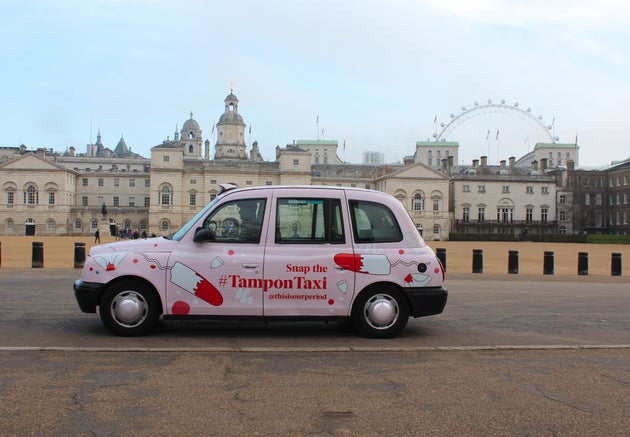
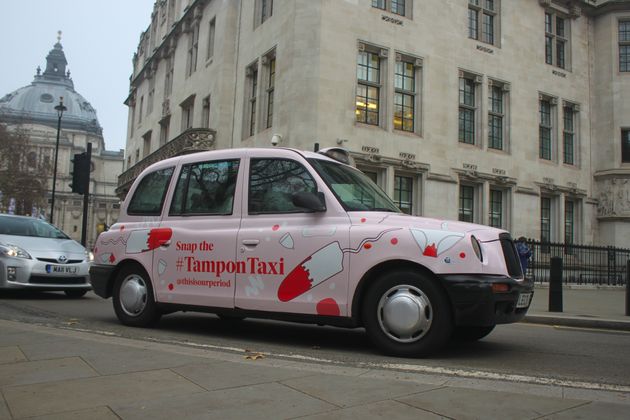
More than 40 per cent of girls in the UK have had to use toilet roll to manage their period because they’ve struggled to afford sanitary products. But campaigners are hoping to change that with a London taxi with a difference.

The black cab has been given a pink makeover and is now adorned with tampons, Mooncups and sanitary towels. It’ll be driving around London from today until 19 December, operating as a regular cab to raise awareness of period poverty both in the UK and abroad.

It’ll also be making some special stop offs on the way, handing out 5,000 sanitary products to women at homeless shelters across the capital.

PROJECT PERIOD

The idea is the brainchild of Holly Bantleman from Project Period, a coalition of period poverty campaigners. Bantleman came up with the idea while having a “cheeky margarita” in an outside bar in the summer and seeing a pink taxi go past.

She hopes the taxi will raise awareness about period poverty, as well as encourage more people to donate and volunteer with period poverty charities.

[Read More: 7 Things You Really Need To Know About Period Poverty]

Through her work, Bantleman has witnessed the devastating impact period poverty has on women and girls both here and abroad.

“The impact on someone’s confidence, on their sense of pride, is huge,” she tells HuffPost UK. “I’ve spoken to women who are unable to take public transport because they’re on their periods and can’t leave the house, and that ends up having an impact on their work and the funds that they’re able to take home to their families.”

PROJECT PERIOD

Period poverty also has a huge impact on education, with thousands of girls around the wold missing school when they’re on their period.

“There are points where I’ve known young girls who have exchanged sex for sanitary products,” Bantleman says.

When girls and women in the UK are forced to use toilet tissue in place of sanitary products, it can leave them worried about leaking, seriously restricting their daily lives.

But elsewhere in the world, Bantleman says loo roll may not even be available.

“People end up using crude materials like banana leaves, mud and rags, which can have an impact on a woman’s reproductive and personal health,” she says.

Campaigns like Project Period are working to ensure that all people who need sanitary products have access to them. The taxi will be driving around London until 19 December – find out more about the organisation’s work here. 

Language and Autonomy

There’s no shortage of serious conversations parents should have with their children. And in the age of the Me Too and Time’s Up movements, one fundamental lesson is the importance of our bodies and bodily autonomy.

“Body awareness talks are the earliest conversations parents can have with young children to support their health and safety,” sex educator Melissa Carnagey said. Conversations about body parts and bodily autonomy lay the foundation for understanding consent and sexual misconduct.

To inform these early discussions, HuffPost spoke to Carnagey and sex educator Lydia M. Bowers about the best ways to explore the topic of private parts and bodily autonomy with young kids.

Here are their expert-backed guidelines and tips for parents and caregivers to keep in mind.

Use The Proper Terms For Body Parts

“Body parts are body parts are body parts,” Bowers said, emphasizing that “penis,” “testicles,” “vulva” and “vagina” are not bad words. Parents should become comfortable using these terms or the corresponding words if they speak a language other than English at home.

“Often without hesitation, caregivers will use accurate terms for body parts like elbow, knee and nose, so parts like the penis, vulva, vagina and anus should be no different,” said Carnagey.

There are several reasons children should learn the proper terms for private parts instead of nicknames. One is that having the right language and context helps kids communicate clearly about their bodies. This is important in the context of telling a doctor or caregiver where something hurts or itches.

“When we avoid saying words, we instill a sense of shame, of something to be avoided or hidden.”

– LYDIA M. BOWERS, SEX EDUCATOR

“Using accurate terms also better prepares them to talk confidently about changes they may experience to their body as they grow, especially to medical providers or in settings where they may be learning about their health,” Carnagey added.

“When we avoid saying words, we instill a sense of shame, of something to be avoided or hidden,” Bowers said. She added that using the correct terms is useful in teaching kids how to keep their bodies clean and healthy. “For proper hygiene, there’s a difference in how the bottom or the penis or the vulva are wiped and washed.”

Avoid Cutesy Language

Although it is tempting to use euphemisms and cutesy language when talking to little kids about their bodies, this can lead to problems.

“One issue is that there are so many alternate terms and many of them have other meanings. This can be risky because it can lead to a child being misunderstood by others, especially if they have experienced unsafe touch to that part of their body and need to report it,” said Carnagey.

Kids should be able to identify body parts as private and correctly name them so that they can communicate if they’ve been touched inappropriately.

“We sometimes give nicknames for body parts ― like ‘piggies’ and ‘noggin.’ But just like we also teach children those parts are actually called ‘toes’ and ‘head,’ they need to know real private-part terms as well,” Bowers explained. “If we’re using cutesy names because we’re embarrassed or ashamed to say the actual terms, we’re perpetuating the idea that some body parts are dirty, bad or shameful.”

Promote Bodily Autonomy In Everyday Situations

“Creating a home culture where everyone’s body boundaries are respected is an important step,” Carnagey said. Parents can do this by not forcing their kids to share affection with others and by getting in the habit of asking for touch ― for example, saying “May I give you a hug?” rather than “Give me a hug.”

Carnagey advised that parents not dismiss unwanted touch between siblings or family members as play.

“In our home, for example, we have an agreement that no one should have to repeat ‘no’ or ‘stop’ before the boundary is respected,” she explained. “It may take some reminding and redirecting at first, but when it’s consistently practiced, children become more mindful of the boundaries of others and come to expect theirs to be respected as well.”

Parents and caregivers can promote bodily autonomy in everyday circumstances like mealtimes. “When a child says that they are full or finished eating, avoiding a power struggle by not forcing them to take one more bite or finish their plate honors what their body is telling them,” said Carnagey.

Bowers pointed out that there are opportunities to teach these lessons while reading books or watching movies. Parents can say things like, “Should that prince have kissed the princess when she was sleeping? She wasn’t able to say yes or no.”

According to her, there are times that parents should not insist on asking for permission, however, like when changing diapers, taking kids to the doctor to receive medical care and bathing young children before they’re able to do it on their own.

“If we ask a child, ‘May I change your diaper?’ and they respond with ‘no,’ we’re left with two options. Either we violate their consent or we leave them in a dirty diaper, which is a health and safety hazard,” she explained. “Instead, we talk through with them. ‘It’s time to change your diaper. Your body did its job to get that out, and now we’re going to take off the dirty diaper. I’m going to use this wipe. …’ We can still show them that their body is worth respect, that we will be intentional and inform of the process.”

Use Books And Videos

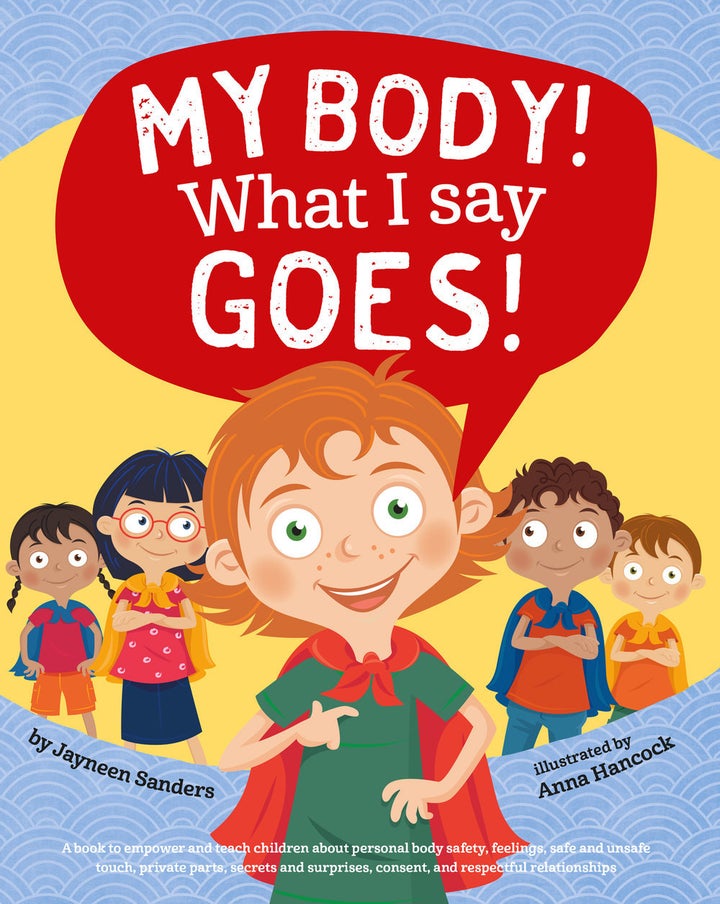
Many children’s books promote themes of bodily autonomy and safety. Bowers and Carnagey recommended Jayneen Sanders’ books, especially No Means No!,Some Secrets Should Never Be Kept and My Body! What I Say Goes! Sanders also has a book geared toward caregivers called Body Safety Education.

EDUCATE TO EMPOWER PUBLISHING
Many children’s books — for example, Jayneen Sanders’ My Body! What I Say Goes! — promote themes of bodily autonomy and safety.

Educate2Empower Publishing, Sanders’ publisher, is a great resource for families because it is an imprint specializing in children’s books on body safety, consent, gender equality, respectful relationships and social and emotional intelligence.

Carnagey’s Sex Positive Families website features a reading list of over 100 books on sexual health for children and families, including many that tackle consent and bodily autonomy.

Bowers is a fan of What Makes a Baby by Cory Silverberg. “It’s a great basic intro into how babies are made, using the terms ‘sperm,’ ‘egg,’ ‘uterus’ and ‘vagina,’” she said. She also recommended C Is for Consent and Miles Is the Boss of His Body.

Teach Kids To Trust Their Instincts

There are ways to help kids learn to trust their instincts, which can be a fundamental step in teaching bodily autonomy and contextualizing difficult experiences.

“Being in the habit of checking in and making space to hear from them how they are doing in a moment is a great way to help increase their body awareness and language around their experiences.”

– MELISSA CARNAGEY, SEX EDUCATOR

Carnagey suggested teaching kids to identify their feelings. Parents and caregivers can do this by asking questions like “How are you feeling right now?” or pointing out when they notice shifts in body language with statements like “I see that you’re frowning. Tell me what you’re feeling.”

“Being in the habit of checking in and making space to hear from them how they are doing in a moment is a great way to help increase their body awareness and language around their experiences,” she said. “This can make them more confident communicators and advocates for their wants and needs along their journey.”

When Your Child Doesn’t Look Their Age

When Your Child Doesn’t Look Their Age

EVGENY ATAMANENKO / SHUTTERSTOCK

Last month, I took my daughter to our local driving school to sign up for driver’s ed. The director took one look at my 15-year-old and chuckled. “You don’t look old enough to drive,” he said. “My 12-year-old niece looks older than you!” He attempted to say it lightheartedly, as if we were all in on the same joke, but as anyone with a shred of awareness knows, unsolicited comments about looking three years younger than your age isn’t a welcome conversation starter for a teenage girl. She was not amused.

My daughter began looking younger than her age when she was about 6. As her peers grew taller, she stayed petite. Her same-aged girlfriends started filling out a full two or three years before she did, and she’s not been thrilled with those differences. “When am I going to grow, Mom?” she often asks, equal parts annoyed and angry at the unfairness of it all. I try to convince her that she’s built just the way she was meant to be, and that she’ll grow if and when the time is right — which, of course, only ticks her off further. I try to tell her there are benefits to being short, but she doesn’t want to hear it. She wants to be tall, to at least look her age, to not have people always pointing out how young she appears.

But there actually are some advantages of having kids who are small for their age. For one, they usually come across as smarter, more skilled, and more mature than their peers. For example, my daughter played violin beautifully when she was 11, but the fact that she looked like she was 8 made it even more impressive. We have a friend whose tiny 4-year-old still wears size 2T pants, so when he opens his mouth and a full, intelligent thought falls out, you can see the shock on people’s faces as they think, “Wow, what an articulate toddler!”

I’ve also had friends with kids on the other end of the spectrum. The kids who look a lot older than their age face a whole host of challenges, from constantly outgrowing clothing to unrealistic expectations. People expect much more maturity out of physically bigger kids, so the judgmental looks come swift and hard toward parents who are gifted with early-blooming children

I have another friend whose son is 6 and is the same height as his mother — and she’s not short. He isn’t just a little tall for his age; he’s ginormous. He wears clothes most 12-year-old boys can wear, so you can imagine what people think when he behaves like a typical first-grader. He’s a little kid trapped in a big-kid body, but strangers don’t know that. All they see is a big kid whose parents clearly haven’t civilized him properly.

Or how about the girls who develop early? I knew someone whose 10-year-old wore a C-cup bra and looked like a teenager in a swimsuit. Talk about unreasonable — not to mention inappropriate — expectations from the public.

I know that this is something parents of developmentally delayed kids also have to deal with — along with a whole host of other issues — so it’s given me a newfound sense of empathy. While having your child’s age miscalculated is hardly a huge life challenge in the grand scheme of things, it can be tricky.

We live in a world where people tend to be critical of kids’ behaviors anyway, and having a child whose insides don’t match their outsides naturally leads to assumptions and expectations that are either inaccurate or unfair. Not to mention, it gets old to constantly have your kid’s physical size be the first topic of conversation, or to repeatedly say things like, “Yes, I know, she’s really small for her age,” or “No, he’s not reading because he’s 3. He only looks 7.”

It’s good for all of us to remember that kids may not be what they appear at first sight, especially when we are tempted to judge. When a mom brings a boy who must surely be 9 or 10 into the women’s bathroom with her, he may only be 5. When you think, “Why is that kid still using a pacifier?” that kid may not be as old as they look.

I actually had to remind myself of this when I dropped my daughter off for her first class at the driving school. You have to be 15 to take the class, but I watched a kid who looked like he couldn’t possibly be older than 11 — no exaggeration — walk in and sit down in front of my daughter. She and I exchanged a quick, wide-eyed glance, and I’m sure a look of pity crossed my face for the poor boy.

My daughter just looked at him and smiled.